
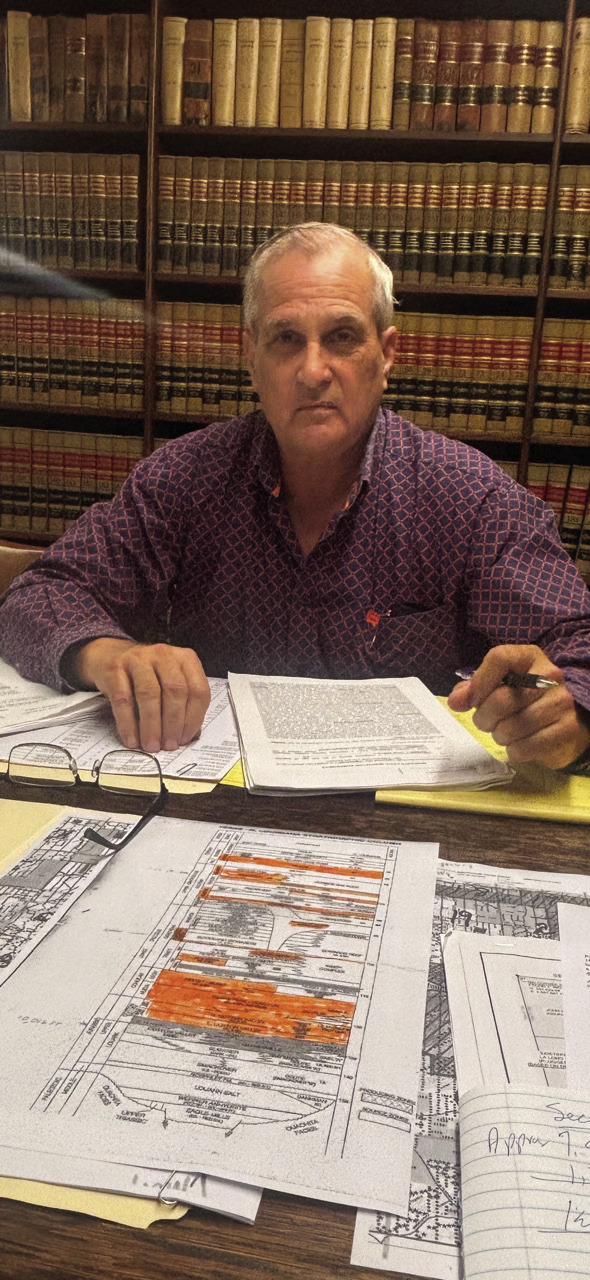
Many Attorney John W. “Billy” Pickett has sounded the alarm. Folks in two areas of Sabine Parish had better wake up and inform themselves about the proposal to create disposal wells for oil and gas drilling waste brought in from other areas. It is proposed the waste be pumped into underground caverns. Probably unknown to most folks, but one well has already been drilled.
There will be a public hearing about the matter on Thursday, Oct. 10, at 6 p.m. at Many City Hall. Anyone interested should attend. The Louisiana Office of Conservation, Injection & Mining Division, will conduct the hearing on the application of Aethon Energy Operating of Dallas for a permit to drill and complete a Class V Subsurface Stratigraphic Test Well in Section 28, Township 6 North Range 11 West in Sabine Parish to acquire geotechnical information. The well will be drilled to a depth of about 7,930 ft. below ground level with cores, fluid samples, pressure measurements and other applicable information to be collected. The base of the lowermost undergrown source of drinking water at this location is about 1,343 feet. Aethon has its eye on 84 square miles of property located west of Hwy. 171 including the Fisher and Negreet areas all the way to Toledo Bend Lake.
A copy of the Draft Permit, fact sheet or other information may be obtained by writing: Ben Gilder, Office of Conservation, Injection & Mining Division, Room 817 of the LaSalle Building, 617 North 3rd St., Baton Rouge, LA 70802.
The great concern about the plan is that the waste stored in these caverns will move and leak through cracks and get into drinking water and could even be released into the atmosphere. The items stored will be under pressure.
The depth of the well is approximately 7,900 ft. Water wells in the area are a maximum of 1,300 ft. deep Attorney Pickett said the waste proposed to be stored includes carbon dioxide, carbon oxides, hydrogen sulfide and other fluids and substances including radon, which is a radioactive waste. The agreement states that the items pumped into the ground will be stored in perpetuity.
The storage rights agreement states the company can operate geologic storage facilities in any underground stratum, including aquifers.
The agreement grants storage servitude on, over, under, through and across the surface and subsurface of the property. This includes logging, demolishing any improvements, right to drill fresh water wells and construction of pipelines. The company has the authority to construct storage infrastructure.
The second piece of land, which is east of Hwy. 171 and south of Hwy. 6, is being operated by DTM Louisiana Gathering of Detroit, MI. On April 17, 2023, they submitted an application for a permit to drill a test well in Section 31, Township 6 North, Range 10 West. DTM was granted permission by the Department of Conservation to drill the well on Jan. 17, 2024 with all work as described in the application to be completed by Jan. 17, 2025. The area controlled by DTM contains 30 square miles.
“Geologists tell us the caverns are sealed,” Pickett pointed out. “There are monitor stations, and I asked the question, ‘What are you going to do if there is a leak?’ I never got an answer.”
He said there are over 1,000 oil wells in these two sections, mostly shallow and abandoned. But he said some are still producing. He continued that there are 13 orphan wells, 11 wells they can’t find, 21 active or shut-in, which means they are capable of producing. Most of these wells were drilled in the 1960s.
Attorney Pickett said he did not know how many people have signed to lease their land. He said if a person refuses to sign, then the state will put them in a “forced pool.” He concluded, “People need to be aware of this.”
He said putting this waste back in the ground is part of “the new green deal.” He said, “No more CO2 can be released in the air. There is salt water and all kinds of carbon compounds pumped under pressure into these caverns. They claim that these pockets are sealed, but how do we know? The earth is continually moving.”
The attorney said, “Radon is a gas that is continually on the move. It is radioactive. In Colorado it is released by the depletion of uranium and is the second leading cause of lung cancer in the United States. It can go to water and can get into houses and stay there. It can come through cracks in the earth and get into the water table.”
His conclusion, “To tell you the truth, it scares me to death.”
This is a very detailed matter with a lot of technical and legal terminology, not easily understood by a typical reader.
Those who live in the areas described are urged to learn all they can and urged to make their wishes known. It may be our lives depend on what happens.