
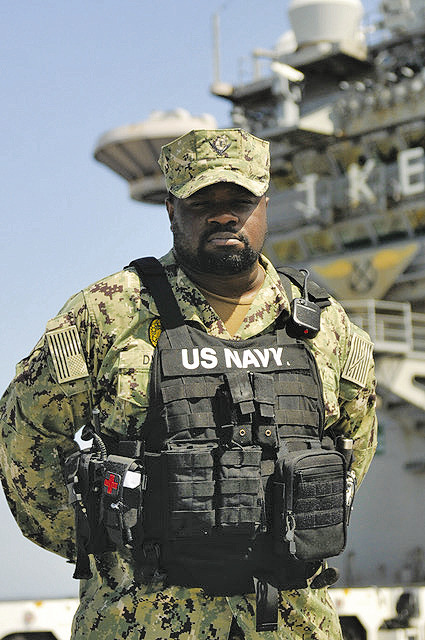
Petty Officer 1st Class Rickey Dykes, a native of Pleasant Hill, Louisiana, is one of more than 5,000 sailors serving aboard the self-contained mobile airport, USS Dwight D. Eisenhower.
Dykes graduated in 2002 from Pleasant Hill High School. The skills and values needed to succeed in the Navy are similar to those found in Pleasant Hill.
“The home training we had growing up had a big influence on me,” said Dykes. “Growing up learning Southern Hospitality, we grew up with respect for others. It was easy for me to transition into military life because I grew up with ‘Yes ma’am’ and ‘No ma’am.’” Dykes joined the Navy 21 years ago. Today, Dykes serves as a masterat- arms.
“I joined the Navy because my dad was in the Navy,” said Dykes. “My dad was stationed in Norfolk and later in Florida. I saw my dad leaving all the time on deployments and thought I wanted to see the world, too. My daughter is in the Air Force, and I’m proud of her for continuing that tradition of service.”
Aircraft carriers are the centerpiece of America’s Naval forces. For more than 100 years, they have projected power, sustained sea control, bolstered deterrence, provided humanitarian assistance and disaster relief, and maintained enduring commitments worldwide.
According to Navy officials, aircraft carriers are versatile and have unique mission capabilities that make them a more strategic asset for the Navy than fixed-site bases. They are often the first response in a global crisis because of their ability to operate freely in international waters anywhere in the world. In addition, no other weapon system can deploy and operate forward with a full-sized, nuclear-powered aircraft carrier’s speed, endurance, agility and the combat capability of its air wing.
“Mighty IKE” is a nuclear- powered aircraft carrier named for Dwight D. Eisenhower, one of only four five-star U.S. Army generals and a hero of World War II who would later serve as the 34th president of the United States. Homeported in Norfolk, Virginia, the carrier is longer than three football fields at 1,092 feet. The ship is 252 feet wide and weighs more than 100,000 tons.
This year commemorates 50 years of women flying in the U.S. Navy. In 1973, the first eight women began flight school in Pensacola, Florida. Six of them, known as “The First Six,” earned their “Wings of Gold” one year later. Over the past 50 years, the Navy has expanded its roles for women to lead and serve globally, and today women aviators project power from the sea in every type of Navy, Marine Corps and Coast Guard aircraft. According to Navy officials, our nation and our Navy are stronger because of their service.
Serving in the Navy means Dykes is part of a team that is taking on new importance in America’s focus on rebuilding military readiness, strengthening alliances and reforming business practices in support of the National Defense Strategy.
“With a strong Navy, we’re able to keep sea trade open, protect nations who are not able to protect themselves and help our allies,” said Dykes. “A strong Navy means a strong America.”
With 90% of global commerce traveling by sea and access to the internet relying on the security of undersea fiber optic cables, Navy officials continue to emphasize that the prosperity of the United States is directly linked to trained sailors and a strong Navy.
Dykes has many opportunities to achieve accomplishments during military service.
“I’m most proud of making it 20 years in the Navy,” said Dykes. “With my first contract, I thought I would be done after five years, but you meet so many good people. I just kept going.”
As Dykes and other sailors continue to train and perform missions, they take pride in serving their country in the U.S. Navy.
“I’m most proud of making it 20 years in the Navy,” said Dykes. “With my first contract, I thought I would be done after five years, but you meet so many good people. I just kept going.”
As Dykes and other sailors continue to train and perform missions, they take pride in serving their country in the U.S. Navy.
“My service means a lot to me,” said Dykes. “That feeling that I’m doing something good with my life means a lot. I love serving my country. If I had to do it over, I’d do it again. I’ve made so many good friends and lost so many good friends. I lost a friend in Afghanistan and another friend who was on the USS Abraham Lincoln, both in a matter of months in 2012. My continued service is a tribute to their memory.”
Dykes is grateful to others for helping make a Navy career possible.
“I had two good friends who helped me out a lot, Chief Masterat- Arms Darrell Flowers and Senior Chief Masterat- Arms Lucus Maxey,” added Dykes. “They’re two of my closest friends and they’ve really been there for me. I also want to thank my buddy, Culinary Specialist 1st Class Milton Brown, who passed away while deployed on the USS Abraham Lincoln in 2012. He was always supportive of me and wanted me to continue in the service.”