
By Daniel Jones, editor
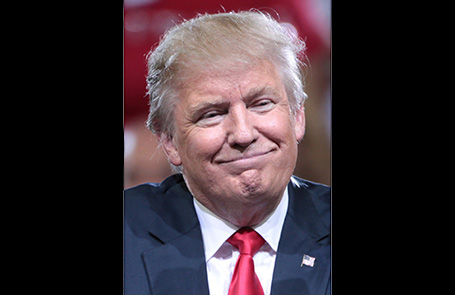
Donald Trump was named president-elect of the United States of America on November 9 after one of the closest elections in decades.
Votes were tallied into the early hours of the morning following Election Day on November 8, which left Republican nominee Trump triumphant with 289 electoral votes to Democratic presidential nominee Hillary Clinton’s 218, with the states of Minnesota, Michigan, and New Hampshire still undecided.
The election was so stunning because every major poll placed Clinton as the eventual nominee in a landslide, which was never to materialize, even though at the time of this article’s creation she was ahead in the popular vote 59,333,856 votes, or 47.7 percent, to Trump’s 59,166,034, or 47.5 percent.
Sabine Parish overwhelmingly supported Trump’s bid for president, giving him 81 percent of local support to Hillary Clinton’s 17 percent. He received 7,877 votes to Clinton’s 1,703. The state went much the same way, as Trump easily led Clinton with 58 percent of the total vote. Libertarian Party candidate Gary Johnson received two percent of the Louisiana vote, while the Green Party’s Jill Stein received one percent.
In the U.S. Senate race, Louisiana Treasurer John Kennedy and Public Service Commissioner Foster Campbell will face off during the next election to be held on December 10. On November 8, Kennedy was supported by 25 percent of the votes, while Campbell received 17 percent. Also receiving a large number of votes were Charles Boustany with 15 percent, Caroline Fayard with 12 percent, and John Fleming with 11 percent.
Sabine overwhelmingly wanted current Congressman John Fleming to move up to the Senate, as he received 3,208 votes in the parish, which equaled to 34 percent support. John Kennedy was second with 27 percent of the votes, or 2,536 ballots total. David Duke, widely known as a former leader of the Ku Klux Klan, received 457 votes from within the parish.
In the race for the fourth congressional district, Democrat Marshall Jones, at 28 percent, or 80,558 votes, will face off against Mike Johnson, who received 25 percent of the votes.
Sabine Parish split three ways in their votes for Congressman. Ralph “Trey” Baucum received 25 percent of the vote, or 2,211 votes total. Oliver Jenkins received 23 percent, or 2,096 votes, while Johnson received 21 percent, or 1,850 votes.
Democrat Van Kyzar was named the Third Circuit Court of Appeals judge narrowly, with 51 percent of the vote, or 53,627 total votes for him. His opponent was Chris Peters. Sabine also preferred Kyzar, who received 62 percent of local votes.
Public Service Commissioner for District Four was also on the ballot. Mike Francis, a Republican, was voted into the office without a runoff with 54 percent of the votes. He was trailed by Democrat Mary Werner with 33 percent and Reldon Owens with 13 percent. Sabine followed that trend with Francis at 67 percent, Werner at 21 percent, and Owens with 13 percent.
Also, the village of Pleasant Hill saw incumbent Bill Thomas defeated by Barbara T. Campbell 58 percent to 42 percent. Campbell received 141 votes to Thomas’s 103.
Keith “Cricket” Manshack was also overwhelmingly voted as chief of police for the Village of Converse with 87 percent of the vote, or 128 persons voting for, with 19 people voting for Chad Ryals.
Amendment 1, which deals with the education requirements of each parish’s registrar of voters was passed with an overwhelming 73 percent of the vote.
Amendment 2, which would have allowed state colleges and universities to establish tuition without legislative approval was defeated with 1,040,659 voting against, which represented 57 percent of those voting.
The third congressional amendment, which would eliminate deductibility of federal income taxes for corporations and set a flat tax rate, was defeated with 56 percent of the vote.
Amendment 4 passed, which will give surviving spouses of the military, fire protection officers, and law enforcement personnel who died in the line of duty a full property tax exemption on their home. A total of 1,298,072 voters approved the amendment, representing 72 percent of Louisiana residents.
Also passing was the Fifth Amendment, which will create a revenue stabilization trust fund to receive a portion of revenues from corporate and mineral taxes and to spend the money on infrastructure and pension liabilities.
Amendment six failed with 58 percent of voters going against. If passed, the amendment was intended to provide legislators a new way to tap into constitutionally protected funds during revenue downturns. With it not passing, the current system will stay in place and the legislature cannot tap into otherwise protected funds.